DateEditor
The DateEditor control contains a dropdown calendar that allows users to select a date. The editor supports multiple display formats for the date value displayed in the edit box.
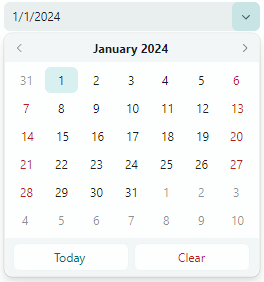
The dropdown calendar contains the navigation header used to browse through months and years. The Today and Clear buttons help users quickly select the Today's date and clear the current value, respectively.
The control's main features include:
- Date selection in the dropdown calendar with the mouse.
- Browsing through months and years using the navigation bar.
- Three calendar views: month view, year view, and year range view.
- Built-in Today and Clear buttons.
- Limiting the available date range.
- Numerous display formats for the selected date value in the edit box.
Select a Date
A user can select a date by opening the dropdown window and picking a date in the calendar that appears.
The dropdown calendar's navigation header allows a user to browse through months and years:
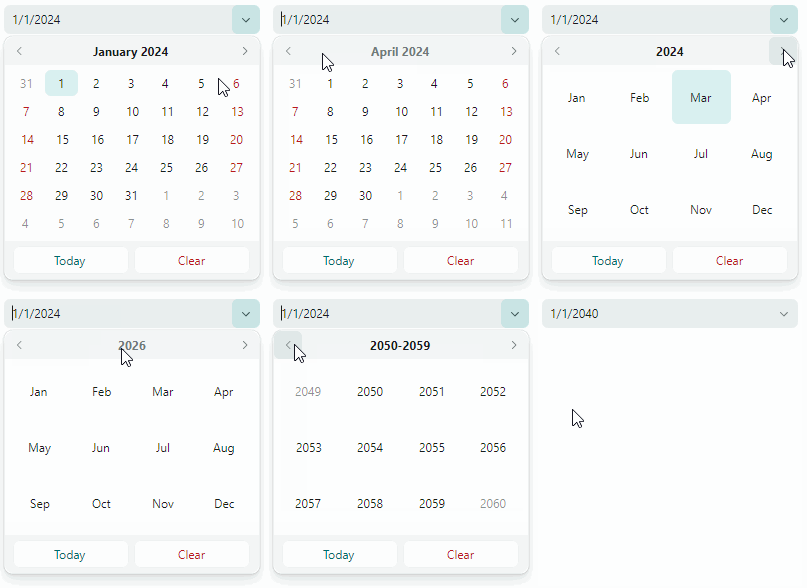
In code, you can specify a date or read the currently selected date with the DateEditor.DateTime or DateEditor.EditorValue property. These properties are in sync. They differ in the value type: the DateTime property is of the nullable System.DateTime type, while the EditorValue property is of the object type as in all Eremex editors.
Customize the Dropdown Calendar
The following properties allow you to set up a DateEditor's calendar:
ShowToday— Gets or sets whether to highlight the Today's date in the calendar.NullValueButtonPosition— Gets or sets whether the ('x') (clear value) button is visible.MinValue— Specifies the minimum allowed date. TheMinValueandMaxValueproperties allow you to specify the range of values displayed in the calendar.MaxValue— Specifies the maximum allowed date.
You can also handle the PopupOpened event to perform additional customizations of the dropdown calendar. In a PopupOpened event handler, the calendar object can be accessed using the DateEditor.PopupContent property. Typecast this property to a CalendarControl class object to modify its properties. See the following example: Example - Enable the Year View When the Calendar is Opened
Example - How to create a DateEditor
The following example defines a DateEditor, sets the initial value and specifies the allowed date range.
xmlns:mxe="https://schemas.eremexcontrols.net/avalonia/editors"

<Window.DataContext>
    <local:MainViewModel/>
</Window.DataContext>

<mxe:DateEditor
    DateTime="{Binding SelectedDate, Mode=TwoWay}"
    MinValue="{Binding MinimumDate}"
    MaxValue="{Binding MaximumDate}" />
using CommunityToolkit.Mvvm.ComponentModel;
using System.Collections.ObjectModel;

[ObservableObject]
public partial class MainViewModel
{
    [ObservableProperty]
    DateTime selectedDate = DateTime.Now;
    [ObservableProperty]
    DateTime minimumDate = DateTime.Now.AddDays(-15);
    [ObservableProperty]
    DateTime maximumDate = DateTime.Now.AddDays(15);
}
Specify the Value's Display Format
Use the DisplayFormatString property to set the display format for the date/time value displayed in the edit box.
Prevent Popups in Read-only Editors
In read-only mode, the default behavior of any popup editor is to allow users to open the editor's dropdown. However, they cannot modify values through either the edit box or dropdown. To disable popups for read-only editors, set the ShowPopupIfReadOnly property to false.
Prevent Popups From Opening and Closing
You can handle the following inherited events to cancel popup opening and closing operations:
PopupEditor.PopupOpening— Fires when a popup is about to be created.PopupEditor.PopupClosing— Fires when the popup is about to be closed.
These events provide the e.Cancel parameter. Set it to true to cancel the current operation.
Customize the Popup When It Appears
Handle the following inherited event to modify the popup or its nested controls:
PopupEditor.PopupOpened— Fires after the popup has been created and immediately before it is displayed. This is a notification event. It does not allow you to cancel popup opening. Handle thePopupOpenedevent to customize the popup or its child controls.
When handling the PopupEditor.PopupOpened event, use the editor's PopupContent property to safely access the control inside the editor's popup. The PopupOpened event ensures that the popup control exists when you access it. For the DateEditor control, the PopupContent property returns an instance of the CalendarControl class.
Example - Enable the Year View When the Calendar is Opened
This example shows how to set a DateEditor's dropdown calendar to the Year view on opening.

The DateEditor class does not provide a public property to change the current view of its calendar. However, the embedded calendar (a CalendarControl object) exposes a public property called DisplayMode. This property specifies the calendar's view mode (Month, Year, or Decade).
This example handles the PopupOpened event to access the embedded calendar when it is created. The handler typecasts the DateEditor.PopupContent property to a CalendarControl object, and then sets the CalendarControl.DisplayMode property to Year.
using Eremex.AvaloniaUI.Controls.Editors;

dateEditor1.PopupOpened += DateEditor_PopupOpened;

private void DateEditor_PopupOpened(object sender, Avalonia.Interactivity.RoutedEventArgs e)
{
    DateEditor editor = sender as DateEditor;
    (editor.PopupContent as CalendarControl).DisplayMode = CalendarMode.Year;
}
Respond to Popup Closing
Use the following inherited event to perform actions after the popup has been closed:
PopupEditor.PopupClosed— Fires immediately after the popup has been closed. This is a notification event. It does not allow you to cancel popup closing.